Sunday, July 31, 2011

Seringapatam

Seringapatam (or Srisangapatna as it is now called), was the setting for the final phase of the Fourth Anglo-Mysore war in 1799. Of note is the fact that a younger Arthur Wellesley, the fourth son of an old  Anglo-Irish Family, commanded the rear of the assault on the fortress and later (allegedly) identified the body of the fallen Tipu Sultan (the "Tiger of Mysore"), the ruler of Mysore.

Now work had taken me to India, and I seized the opportunity during a free weekend to drive over from Bangalore to see the old royal city of Mysore. Along the way my driver decided to show me an ancient temple in the midst of an old ruined fortress. It was only when we got to the memorial to Tipu Sultan did I realize we were at the site of the Battle of Seringapatam.

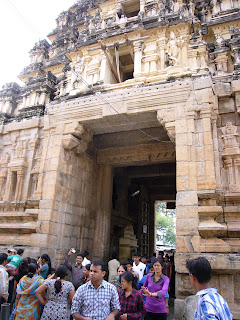
Now the temple itself (Ranganathaswamy Temple) is spectacular, and in good condition considering it's over 1000 years old (I believe it was built in the 9th Century). My driver Shiva was a fairly devout Hindu, so we went in and while he prayed I managed to take a few shots of the beautiful carved figures.


The fortress though is largely a ruin, with only some of the original walls remaining. The pictures below show where the main body of British troops under Major General David Baird stormed the walls after a breach had been opened up by a battery of artillery placed to the south. The ditch and glacis beyond the walls are impressive, and give an indication of the difficulties faced by the assaulting British columns.

Main walls facing south
Main gate facing south towards British Battery position
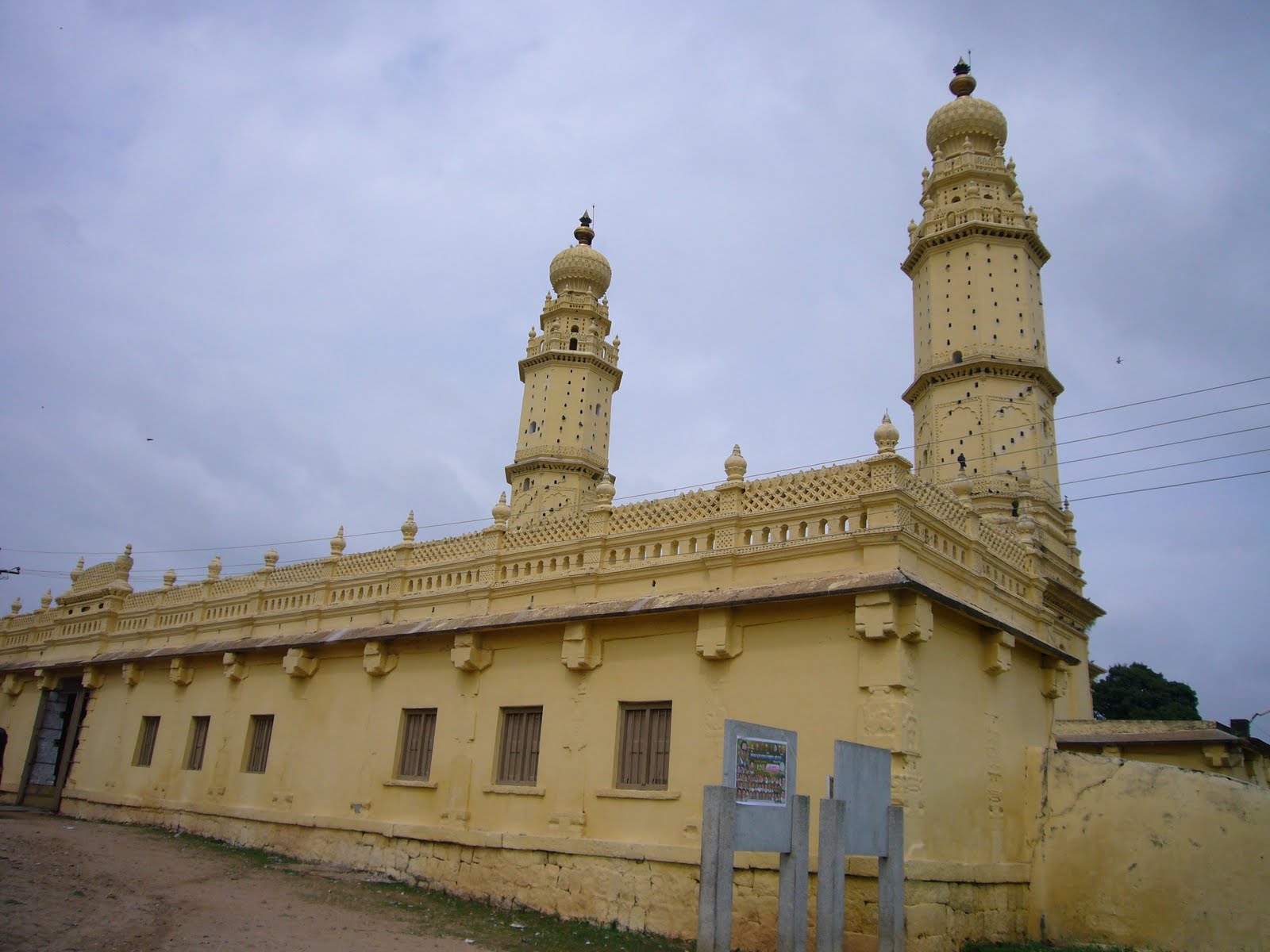
 Apart from the ancient temple and the fortress ruins, there are the remains of the porticos of a few original buildings from the period as well as the Mosque of Tipu Sultan, who was an Islamic ruler in an Hindu land. The area of the battle itself is undeveloped, and apart from the walls which are mostly in ruin, the battlefield seems to be largely as it was in 1799.

Tipu Sultan's mosque

Wednesday, June 01, 2011

Battle of Jankau - Maps

So, my research for the battle is ongoing as always... Some of the fruits of my digging recently are these nice copies of the battle from Theatrum Europeaum from the University of Augsburg's online document library. I am not aware of any copyright for these images so here they are.

Both images were drawn a number of months after the battle, and it is obvious that the artist (Matthaus the Elder Merian) must have visited the site as they are topographically very accurate (I should know as I walked the battlefield again a few weeks ago).

The first image below is the view of Chapel hill looking over the battlefield on the day before the battle. As we can see both the Swedish and Imperial armies kindly burnt down a number of the local villages during their respective marches, and the Swedes are alleged to have pillaged and burnt down the rest after the battle (according to local folklore the area was almost uninhabited for a few decades after 1645).


The second picture shows the closing stages of the battle as the Swedes pushed through the Hartmany wood. It actually captures a number of phases at the end, including the final unexpected Swedish attack as the light was falling, the capture of Hatzfeld and the rout of the Imperial army.


There were a total of five pictures of the battle, and the order of battle in Theatrum Europeaum, indicating the contemporary importance of the battle. The vantage point of the second picture was probably in the vicinity of the village of Nosakov, looking north to Jankov and Ratemerice.

Monday, May 30, 2011

Battle of Blenheim / Blindheim 1704


The advantage of Prague as a city of residence is the easy reach of many famous battlefields, and equally fine military museums both in Bohemia, and neighbouring lands. Thus on a recent trip with a good friend from Cork, I managed to get to the Blenheim battlefield. Now admittedly  this is not exactly a quick drive from Prague (it took 4 hours)), and it was taken in during a short tour around Bavaria.

Below is the original Blindheim church where the French right wing under  Clérambault were surrounded and eventually surrendered. The Danube river originally flowed quite near to the village, initially providing the French with a natural flank, against which they were eventually trapped. The course of the river has since moved considerably to the South-east


Apart from a slight sprawl from the village of Blindheim, the battlefield is largely intact. Stretching four odd miles or so from the hills of the Swabisch Jura to the Danube, the topography is fairly flat. The picture below is by the Nebel, looking North-east towards the British centre (and in the distance the village of Wolperstten

Running through the middle of the battlefield, is the Nebel, which is now nothing more than a small stream and ditch, though which at the time of the battle was a wider, and much marshier large stream.


The pictures were taken from Marlborough's centre, where he launched his main attack against the weak dividing point between the French and Bavarian wings of the Franco-Bavarian Army. Below is the view from the British centre towards the French left wing. The village of Blindheim has grown a fair bit to the north since the days of the battle, and where the houses are now would have been open fields. The original Blindheim church (which is pictured above), can be seen in the distance on the left of the photograph.

Unfortunately we didn't have time to visit the museum in Hochstadt, where there is an excellent diorama of the battle. You can see it here:

http://en.wikipedia.org/wiki/Image:Battle_of_Blenheim_Diorama.jpg

Salute 2011

Well, the last month has been been quite hectic, what with a new job, travel and many other drastic changes to my routine. Anyway, luckily I managed to get myself over to London for the annual Salute show. Now allot has already been written and photos published on other sites and blogs, so I will not try to replicate anything here other than some personal highlights and the odd picture from some games which I found inspiring.

So, it was my first visit to this show, and the first visit to a large wargames show for a few years since I made it up to Crisis in Antwerp with the rest of the Prague Wargames Club to put on an exhibition game (it was a modest Great Northern War presentation in 10mm). Needless to say the place was packed to the gills. I'd got an advance ticket which seemed to get me in a bit ahead of the other crowds.

The quality of games encountered was very high indeed.  For terrain and overall effect the favourite had to be the huge diorama/game/presentation of the Battle of Gallipoli by Battlefront. Hats of to the gentlemen who designed it.

 
A close second had to be the large alternative English Civil War Siege of Worcester by a Club from Crewe and Nantwich. A couple of ghoulish public execution vignettes set the scene for the period.


My third favourite had to be the Lance and Longbow Society's presentation game of Verneuil 1424. I found the modelling on the buildings and fortifications to be first rate.


As usual, I left the show weighed down by a tonne of AWI lead from the Perry brothers stand (very nice people I have to say; friendly and extremely helpful).

I also managed to swing by the Pike and Shot Society's stand, and spent a good hour talking to Neil Ronnaldson, and drooled over all those splendid books by Robert Hall et al. Oh, and much fun was had at the Too Fat Lardies table (I highly recommend their Sharpe Practice rules).


Sunday, April 03, 2011

Battle of Jankau (Jankov, Jankow) 1645


So a taster of things to come. Spring finally sprung in Bohemia, and myself and Wife decided to decamp from Prague for the day and visit the family country cottage down south (it’s called “chalupa” in Czech). Now for a history buff like myself, it’s an absolute joy as it stands right in the middle of the battlefield of Jankov (Jankow, Jankau), allegedly the bloodiest battle of the Thirty years War, where the Swedish Army under Tortenson, annihilated the main Imperial army (including all the Bavarian cavalry) under Hatzfeld. The dramatic change in strategic strength of the Swedes vis-à-vis the Hapsburgs certainly helped set in motion renewed efforts to end the conflict, which concluded with the Treaty and Peace of Westphalia three years later in 1648.

Our route took us along the first phase of the battle from Broumovice, along the road parallel to "Chapel Hill", towards Ceckov and past where the main body of fighting in the first phase of the battle took place in Nosakov, and the hill where the Swedes stationed their large artillery train. (The picture above is of Jankov in the distance from the flanking route of the Swedish Army. The picture below is looking up towards "Chapel Hill" where the first early morning encounter occured).


The Swedes attempted what was probably one of the first flank marches in early modern warfare. Seeking a way around the Imperial left wing the Swedes came down from the ridge to the west of Jankow, and followed a South-Easterly route concealed by a number of low lying ridges and forests. Unfortunately for them they crashed into Imperial pickets stationed far to the south of the Imperial left flank. The Imperials alerted, began to change position to meet the early morning attack and the battle was begun.

Below, from a point on the Swedish Flanking march, looking towards Jankov to the North-East. The dark area on the middle horizon is the Hartmany forest. In 1645 this would have been much larger. This is where the main Swedish and Imperial forces crashed into each other by mid morning, and where half the fighting took place (phase 2 as marked on the map above). The Imperials then retired to a final position on a low ridge just behind Jankov village.


As the area has never really been developed, the battlfield is almost intact, and also makes for an excellent cycling trip.I will be paying a longer visit to Jankov in the coming weeks, and will provide a more detailed photo journal.

Introduction


This is a blog that is dedicated to my interest in Military history, and in particular, walks, impressions and photos of various battlefields and museums both near (to Bohemia) and afar. Given my base in Bohemia (that's Czech Republic to the uninitiated) I’m quite spoilt for choice when it comes to some major armed altercations between various Emperor’s, Winter Kings and other downright chancers (the battles of Austerlitz, White Mountain, Jankau, Prague, Kolin and Konigratz to name but a few), while various museums and country Chateaus in and around Prague are stuffed to the gills with Military memorabilia, flags, banners and weapons from the Hussite wars right through to WW2. Very much the crossroads of Europe with all its attendant wars.

The title of this blog and the picture above are of course related. Maximillian Ulysses, Reichsgraf Von Browne, a member of the "Wild Geese" those Irish professional soldiers, exiled from their homeland, and in the service of the Sovereigns of Continental Europe. I have alot of time for this particular historical figure, and like the Empress he served, was notable for his integrity and humanity, in contrast to his opponent Frederick of Prussia. This particular Goose was probably one of the more famous and accomplished; ending his days as the commander of the Austrian Army of Empress Maria Theresa, battling and outmanoeuvring Frederick the Great at the Battle of Lobositz (today Lovosice in the Czech republic), and finally dying of his wounds after the battle of Prague in 1757. He is still buried in the Loreto Chapel in Prague. Anyway, he is appropriate motif for the blog. There will be more about this extraordinary gentleman in future posts.

Originally I had toyed with the idea of dedicating this blog to a particular period, but as my interest spans a diverse number of wars and conflicts, I thought it better to keep the focus a bit broader (though it is fair to say that to a large degree it will involve the horse and musket period, and one or two defenestrations).

Apart from the history bug, I was also infected at an early age with the wargaming bug, so will also be posting titbits from various games, rules we have tried (mostly General De Brigade and its variants), figures I like and pictures of those that I have painted. That is to say, a lot of Napoleonic’s, more Seven year’s War, some Thirty Year’s War, and new forays into the worlds of American War of Independence, Napoleonic Skirmish, First Carlist War and 28mm English Civil War. I hope to be able to post something each week and photos of games or figures every other week.

Given that I should have started this blog a least a year ago, I have a backlog of items that I will start posting quite soon. So please read on….