Showing posts with label Dux Britanniarum. Show all posts

Thursday, December 26, 2013

Roman Limes Watchtower continued

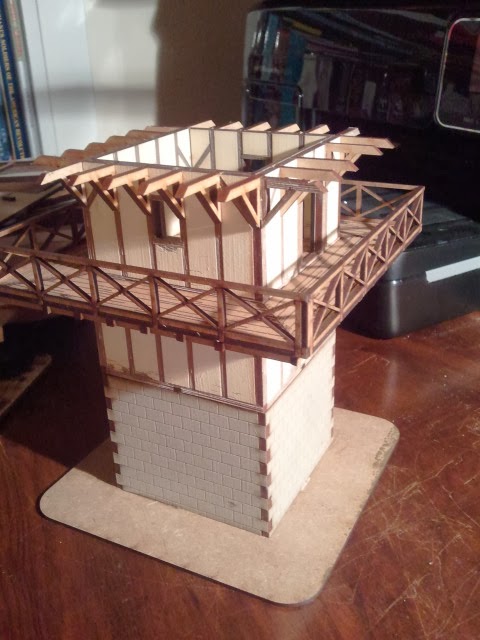
So I really got in to the modelling groove last night once all had gone to bed, and calm descended on von Browne mansions. Carrying on into the wee hours, I managed to get through nearly all the stages of constructing the Roman Watchtower from 4GROUND Models.

As I mentioned yesterday, this pre-painted model is excellent, the quality of the parts and how they are laser cut is first rate. That said though, there are quite a lot of parts to put together. The construction is not fiddly, though with some of the longer beams and supports you have to be careful when removing them from their frames as they can easily bend or snap (e.g. in the picture above I had to re-glue one of the long beams).

There are three main sections to construct in this model: the base/cellar section, the mid tower/sleeping quarters, which also support the observation balcony, and finally the upper floor of the guard room, with a door onto the balcony, and supports for the roof. (Above and below you can see the three sections before gluing the balcony onto the mid level supports).
 
Above a close up of the balcony and trellis guard rail. The detailing really is superb.
Below you can see the three sections fitting together, and finally with the balcony glued on.


The final stage was to construct the roof. I found this the most awkward bit, as the piece did not really have a tight fit. It took a couple of attempts to get it right, and then physically hold in place while the glue dried sufficiently. Below you can see the finished article, and some images of the detailing inside the guard room and sleeping quarters. You can also appreciate how many joists and supports have to be glued into place.


 All that's left to do is to sand and detail the base, and then glue the entrance ladder in place.  I can't praise the model enough, and this will be a great addition to my wargaming table.

Wednesday, December 25, 2013

A little Xmas present to myself

Now just having survived two Christmas days with kids and in-laws (though they are very nice people), it's great to sit back, glass of wine and cheese and crackers to hand. Of course Christmas is really focused on the children, young and old, so as a treat I ordered the 28mm Roman Watchtower from 4Ground (along with some Roman carts). This arrived 2 days ago and was opened today, and a lovely piece of kit it is too.
It comes pre-painted and laser cut into smooth hardboard. As you can see from the various pictures the detail is perfect; really a pleasant surprise. This will be part of the growing Dux Britanniarum campaign at the club, specifically for one of the main raiding scenarios for the Saxons.
Above you can see details of the roof, exterior walls and flooring. The roof now seems to come in a terracotta red, rather than the slate grey advertised. It still looks great though.
Above doors and first floor walls. Below the balcony flooring and trellis guard rails.
This will be thrown together in the coming days in between some frantic Analogue Hobbies Challenge painting. I'll post up more shots soon on the construction of this lovely model, and see if the instructions are any use (thoughts of "Zen and the Art of Motorcycle Maintenance" spring to mind...). Now back to the cheese and wine...

Tuesday, November 12, 2013

2nd game of Dux Britanniarum (with less testing and more playing)

We managed to roll out the muddy golf course that are our current gaming tiles at the Prague Wargames Club for another tale of daring-do's (and sometimes don't's), with a very bloody maul of a Saxon raid on a Romano-British church (no the lads above are not queuing up for confession).
This was the second raid in our new campaign. The Saxons received a bloody nose during their last raid on a Romano-British village. As a result they spent two months nursing their wounds and rebuilding their force. In the meantime the British Lord had lifted enough money (filty lucre) off the Saxons to be able to bribe his warriors to declare him Praefectum (a higher rank on the road to kingship).

The Saxons, still short of cash need to continue raiding until their Warlord has enough money to bribe his way up the social ladder. Only then will he have enough prestige (and cash) to attempt full battle with the British and try to seize a provice, and eventually a kingdom (the Saxons above starting the raid; their target the church in the distance).
Now the Saxons were staring with a -1 to Army morale as they had lost the last raid. They were lucky and got four turns of moves before the British could enter the table. Once at the church they had to pass two looting tests to find the gold. But could they? No, they passed one test (a 5 or 6 on a normal die) and then failed every other one, and sat for the whole game stuck in the church trying to sniff out that last golden chalice.
With all the dithering at the church, there was nothing for it but for the Saxons to get stuck in to the British vanguard to give the boys at the church more time to find the loot and then leg it off the table. (Saxon Hearthguard charging towards the British, followed by the Saxon warriors).
The two elites Saxon units, with Saxon Warlord and champion attached, ploughed into the British Hearthguard, and bounced off! The British played the Shieldwall braced card from the Fate Deck, and the Saxons the Aggressive charge card, which cancelled each out.
The Saxons reeled backwards after a poor dice roll and losing nearly half their men. They were then hit immediately by a fresh group of British Warriors; more casualties (9 now out a total of 12) and then a stack of Shock Points. This added up to more than twice the number of remaining men, and so the two Saxon units routed automatically (Losing ones Amphora). The remainder of the Saxon elite routing off the table below.

The next effect of this mess was that the Saxons had to take an army morale test as two elite units had routed. This led to Saxon army morale being halved (get to 0 morale and the whole army routs off the table).


Dead from the elite Saxon units loitering somewhere in Elysium, or is that Valhalla.


The British tide of units kept coming on as the raiding party was still fumbling with the Vicar's drawers in the church. There was nothing for it but for a combined group of two Saxon Warrior units to charge into the British to delay or hopefully rout some of their opponents.
 
They piled into the British Elite unit and smashed them, but in doing so sustained huge causalities and shock points in turn. The British broke first, but it was a Pyrrhic victory, as the excess shock points then routed both Saxon units. (the result of the final bloody encounter below).
Below, the Saxons still messing around in the church, as the Saxons square up for their final charge.
With the two units of Saxon warriors running for the hills, the Saxon Army morale fell to 0, and it was game (or raid) over.


Again, like the first game, everything ran very smoothly with these rules. The Saxons now have their tails firmly between their legs and must sit out another two months while they recover from their losses.  They can raid again in July, but the campaigning season finishes in September, so they really need a successful raid soon. The next raid will also see them start on a -2 to morale after this defeat. What will it be? hit a wagon train, rustle some sheep, or torch a watchtower. More Lardie mayhem to follow soon with this excellent set of rules. (All figures and buildings by Gripping Beast)

Tuesday, October 29, 2013

First test game of Dux Britanniarum

After reading many positive reviews of Dux Britanniarum, and having had great games with Sharp Practice, I got the full set of the game along with printed cards a few weeks ago.  I had already tried out the other "Dux" (Dux Bellorum) a while back, which itself was very good for larger stand alone battles.

I don't need to repeat in detail the high production values, but it's all there and the cards are a nice touch.  The rule mechanics seem straight forward, as is usual with the Lardies rules stable, while the addition of a separate Fate Deck of cards really makes for a dynamic game.


We decided to start with a test game, which was also the first encounter of the campaign. As others have mentioned, the campaign system is the real draw of the rules. This first encounter was a Saxon raid on a Romano-British village. As part of the campaign system the Saxon Lord has to build up wealth (or "Filthy Lucre") through a series of village and cattle raids, as well as raids on wagon trains and Churches. With a sufficient amount of victories he is able advance his social position and eventually bribe his warriors to declare him Warlord. Only via this process can he gain the fighting units and social prestige that will eventually allow him to conquer his first province and hopefully set him on the road to conquer a small kingdom.


The Kingdom coming under attack was the North British one of Rheged, and the raid was on the province of Caer Brogwm (just south of Hadrian's Wall in what now would be Cumbria). The Saxons were attacking from Coriosopitum in the old Kingdom of Bernaccia (current Northumberland) which had recently fallen to the Saxons.

The task for the Saxons, pretty much like a modern bank robbery, was to get in, find the stash of gold in the village and get out quickly. The objective of the British was to stop, catch or hinder them in every way possible (basically try to wipe them out).
 

The Saxons were led by a new Lord, Aethelfrith (pictured at the very top with his champion), who was on his first raid, supported by two other nobles, Eadric and Theobold. As you see, in the rules there is a character generation procedure before the campaign begins. This is a nice touch, and gets you closer to "owning" your force (the characteristics that you have to roll for will also effect how they perform in the battles and campaign).

In this particular raid, the Saxons managed to get a four turn head start before the British turned up. This was enough to get the second-in-command and a band of warriors into the village to start searching for the gold (Eadric above cajoling his warriors to find the loot).


The British when they did arrived turned up in the middle edge of the table, half way between the village and the escape route for the raiding Saxons. They then proceeded to slam into the back of one unit of Saxon Elite Warriors (see the picture above), who lost a few casualties, but more importantly took a lot of shock points, indeed many more than they had men, and so triggered what was an automatic rout (called "Losing your Amphora") from which there could be no rally (the remains of the unit rout below).


To stall the British further I sent a combined unit of two Warrior bands, with the attached Saxon Lord and his Champion (this gives multiples of points in Close Combat). To this was added an "Aggressive Charge" Fate card which added more advantages, though the British played a Shield wall Braced Fate Card as well, plus the British in Shield wall will always ignore the first kill inflicted on them. Now the Fate Deck cards, plus some good dice, can be key to any encounter and are at the heart of the combat mechanism. Each side get 5 cards at the start of the game, and can use the cards or hoard as needed. Each of the cards confers a certain tactical advantage in combat (or evading it). In some instances you can play multiple cards in one Close Combat, but each noble can only pick up one card at the end his activation, so you have to be careful how you use them.


Anyway, in this instance the Saxons manage to rout one unit, though the second held. In the next few rounds of combat though, the British Shield wall wore the Saxons down and they finally routed.


During this period of fighting the other Saxon warband was searching through the village and finally after 5 loot tests to find the gold came up trumps and started the long journey back off the table while trying to avoid the British (you can't fight and carry bags of gold at the same time).


Now the other thing that was happening was that the Saxon army morale was slowly counting down. With each routed unit the rest of the force has to take a morale test, the result of which will reduce army morale. Once army morale gets to Zero then the whole force abandons the table. Each starts the game with a morale of 5, and then with some dice rolls during the start phase this can be pushed up to a maximum of 9. Lose a raid, and in the next campaign games your force starts on a -1 to morale, encouraging the player to be a bit cautious.


In this case, the rout of one Saxon unit dropped army morale below zero, and the Saxons fled the field pursued by the British. They had taken moderate casualties which meant that it would take 2 campaigning months for the force to recover. The British as winner got to keep the gold and some more from the Saxons, and could replenish their losses faster, thus giving them a free hand in the next campaign month. If the Saxons had won, they could have had an unopposed raid the following month to increase wealth, and with that perhaps increased the lord's status and even hired extra units for the next raid or battle. I think this gives you an idea of how good the campaign system is, and how it informs the table top game.

I really can't recommend the rules highly enough. All the figures and buildings were from Gripping Beast, apart from Aethelfrith himself, who is a really well sculpted figure from Musketeer Miniatures.