Thursday, February 28, 2013

The Battle of Fuentes De Onoro - May 1811


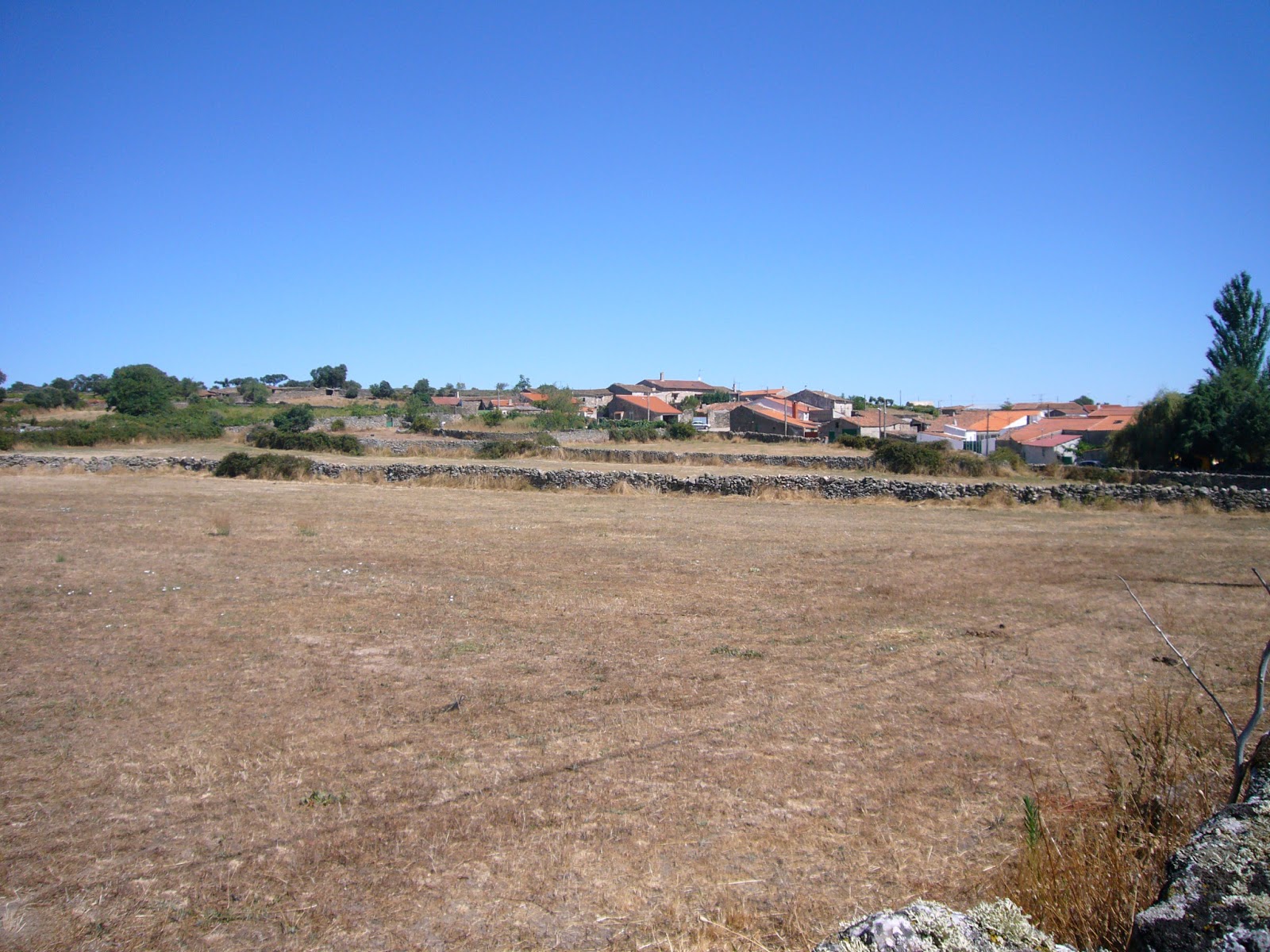
Fuentes de Onoro is a relatively short drive from Ciudad Rodrigo, about 24 Km due west on the main road (A-62) to Portugal. The village is very sleepy, and appears quite empty. As I said before the area really reminded me of the West of Ireland on a sunny day (a rarity in itself).  I had an easy drive on a sunny morning out of Ciudad Rodrigo and stopped at the village on my way to Portugal.
Dry stone walls lined the roads, villages and countryside all around, and the landscape looked fairly green for Spain. The village itself is a warren of small lanes and mostly low dry stone buildings.
The village was fairly bleak, and had a very isolated atmosphere; essentially a poor farming borderland.
This was one of the two main routes between Spain and Portugal that I mentioned in my Badajoz blog. Control both routes and you have the key to both countries, depending on which direction you're either attacking or defending from. In 1811 it was the French turn to attack, almost simultaneously in the North and South (the Battle of Albuera took place 10 days later). Both battles were actually attempts to relive the sieges, in this case of Massena trying to help the garrison at Almeida, and prevent Wellington from gaining control of the northern gates to Spain.

I've included a map of the battle below raided from Wikipedia (and source referenced), as it's hard to get a feel for the battle by just looking at the fields.

http://upload.wikimedia.org/wikipedia/commons/a/a7/Battle_of_Fuentes_de_Onoro_map.jpg 
Map Source: Gregory Fremont-Barnes (main editor) - The Encyclopedia of the French Revolutionary and Napoleonic Wars, page 395. Adapted from Paget 1997, 126.

The notable thing about this battle, as with Albuera, is how in both the French very nearly outflanked the Allied armies. The lie of the land in Fuentes De Onoro, and the presence of Wellington, meant that the British were not caught so unawares as Beresford was in Albuera. Both battles were "Close run things" , which nearly ended in British defeat.

Wellington never considered the battle a victory, though it witnessed the best performance of Craufurd's Light Division in any engagement during the Peninsular War (the Light division’s finest hour), who saved the isolated 7th division on Wellington's right flank from destruction and enabled him to reposition his right wing after being effectively outflanked by the French army. (This was a big change from the near debacle at the battle of the Coa the previous year when the Light division came close to being cut off on the wrong side of the river, in front of Almeida, avoiding annihilation.)

An oft quoted remark attributed to Wellington about Fuentes de Onoro is that had Napoleon been there, the British Army would surely have been lost.

Looking east from the village towards the line of the main French advance. The flanking move would have begun in the distance and proceeded to the right of the picture.


What of course is apparent as you go through the images is that it is perfect light infantry country. Though the route back for the exposed 7th Division from Poco Velho covered by the Light infantry was over mostly open-fields swarming with French cavalry, which underlines the scale of their achievement.

Below you can see a view out over the right flank from the ridge behind the village. This is the ground over which the British right flank retreated.
Looking up to the position of the new defensive line on the ridge taken by Wellington from the south side of the village.


The beginning of the more open farmland to the south of the village - the "exposed" right flank.


Up on the ridge again looking south from behind the village. The village is to the left of the picture.
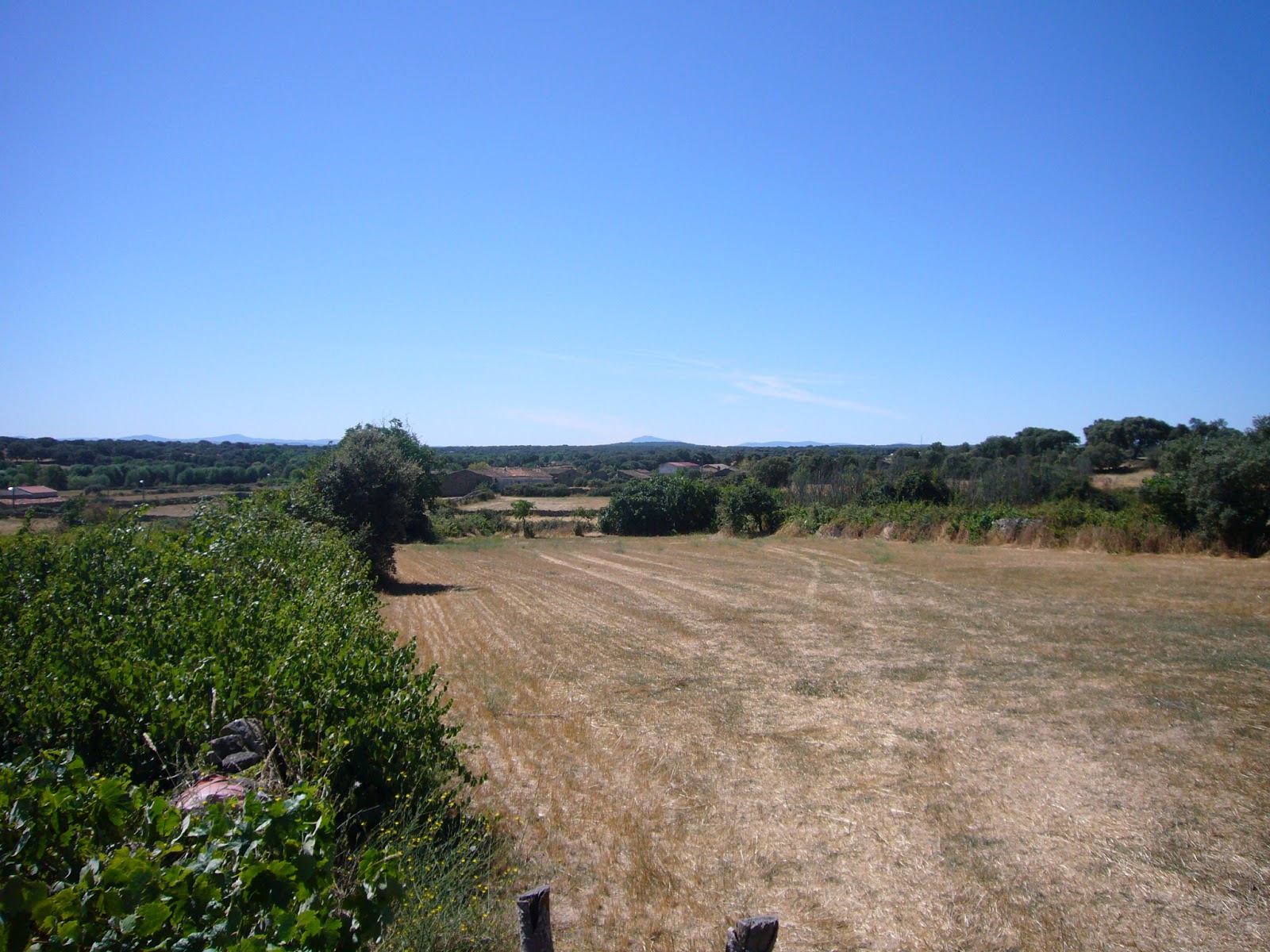
Again on the ridge looking south-east. the village is in the middle distance.

What is apparent is that the slopes of the slope up to the ridge are criss-crossed with low stone walls and trees/hedging. behind this was the village itself full of narrow lanes and packed with one story farm buildings. This made for a very difficult obstacle for the French, and witnessed the bloodiest fighting of the day.

The Church in the distance in the centre of the village viewed from the position of Wellington's new right flank.

The old main road runs through the centre of the village, past the old church and up the hill, travelling west to the nearby border post with Portugal.
by most accounts the church is mostly as it appeared at the time of the battle. There is a small stone memorial to the battle there.


There is also a memorial to the fallen Nationalist heroes of the Spanish Civil war. Someone seems to have tried to pull the plaque off or damaged it. As in Ciudad Rodrigo, one can speculate that not everyone locally is happy with these monuments to Franco's men.

The main road coming up the hill. Even now you can see how narrow the way is. This was the line of the first attack by Ferrey's Division in trying to take the village, and then by Drouet, only to be thrown out again by the 88th Connaught Rangers Foot.


Just back from the top of the village on the ridge is where Wellington and his officers had their HQ. looking north along the line of his other regiments' positions (centre and left flanks).


k
Looking south from Wellington's position above the village.
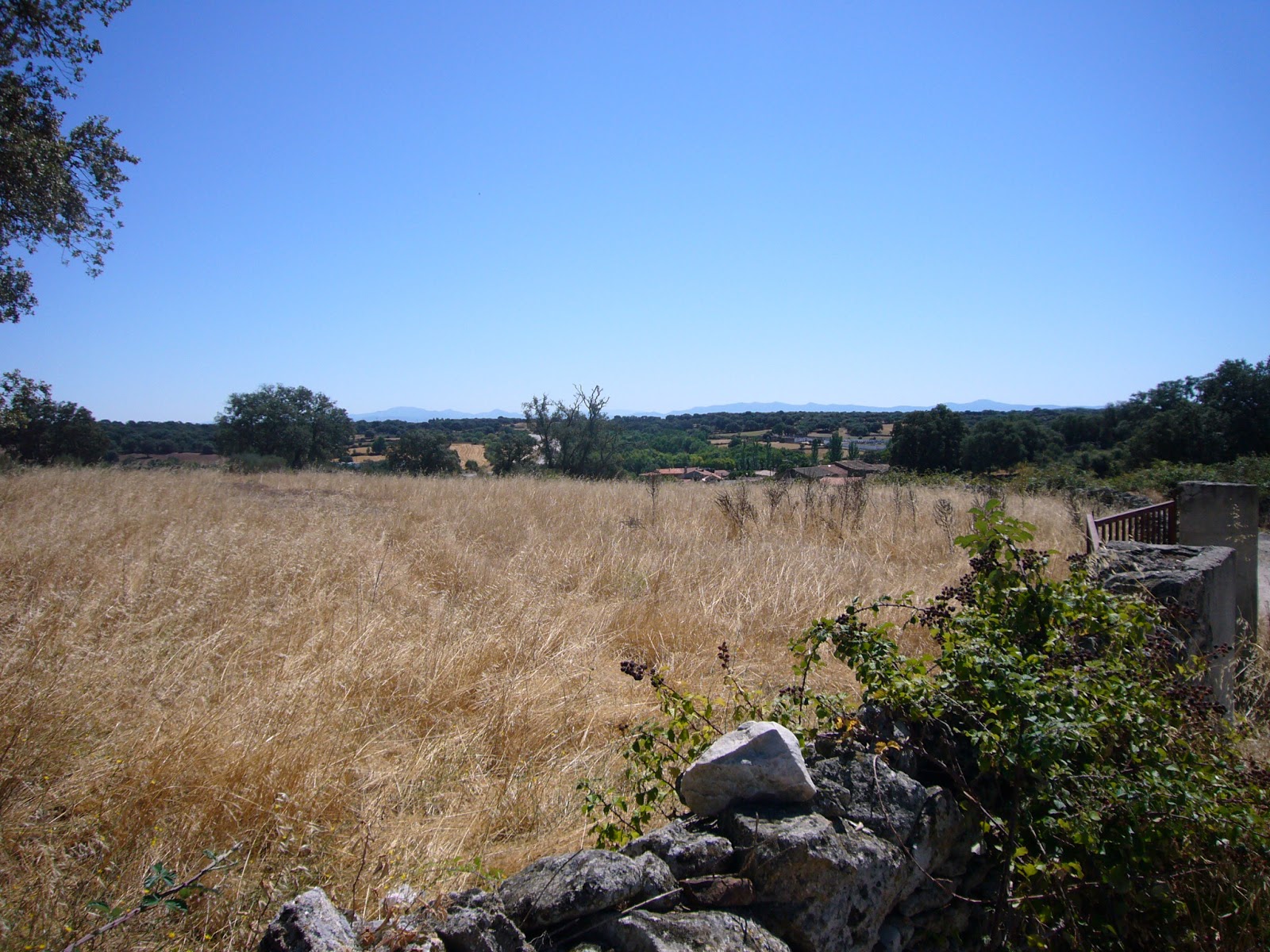
Looking North along the ridge where the rest of Wellington's army was positioned facing east towards the French (centre and left flank). In the distance you can see the beginning of Vilar Formoso.
The onward journey to Almeida is short as well, so making the area a good destination for any battlefield tour. Basing yourself in Ciudad Rodrigo you can take in Almeida, the Coa, and Sabugal, and in the other direction you are about 80 km from Salamanca, which is easily accomplished as a day trip. Anyway highly recommended.

From Here I drove on to Almeida, Sabugal, and then down into Portugal to Bussaco which I reached in the evening. More on these battlefields in the next posts.


Wednesday, February 27, 2013

Dux Bellorum: More Gripping Beast Early Saxons - WIP

So the Saxons are coming! (or nearly here if I can get over my painting mojo and finish them). All from Gripping Beast, and very nice too. I'm still thinking about how I will do banners, but will likely go with Paper banners for the Nobles and Companions, and Dracos for the Ordinary warriors/warbands. I suspect that these warbands carried nothing into battle, and just the warlord/chieftain and his household had a banner. The eye-candy Department of History will win this academic debate though, so Dracos it is...

I've set myself a deadline of next week to get them done, backed up by agreeing to field them for one game then (so they have to be done!)
 

Shield transfers are by LBM, and look very natural. Obviously they need a lick of Matt varnish to take the shine off, and blending in some colours from the shields edge. Otherwise very quick and easy to apply. The trick is to have a clean white undercoat on the shield.


All the figures are on 12cm x 6cm bases (Impetus standard)

Here are the next wave of figures, a few  highlights and shield transfers before completion. In total this will give me a Dux Bellorum 32 point army consisting of 1 base of Companions, 2 bases of Nobles, 5 bases of Ordinary Warriors and 2 bases of Skirmishers (bow).
 
As always, Gripping beast produce some wonderfully animated figures. These ones from their gruesome Early Saxon casualty set.
 
I'll post up more shots once the basing is complete, and then some games.

Tuesday, February 26, 2013

Decree by Eugène Napoleon (de Beauharnais) in the Kingdom of Italy - 1806

I was picking up an antique chest of drawers that Mrs.Goose had found in an old antique shop on the outskirts of Prague. Whilst I was waiting for the chest to be covered for moving I noticed the old print above hanging in the corner. I asked the owner how he came by it and if it was for sale. He said his partner picks up curios in Northern Italy and this was something he's brought back. It had been hanging there for a few years and little interest shown. So I took it off his hands for 40 Euros, and now it's hanging above the desk.
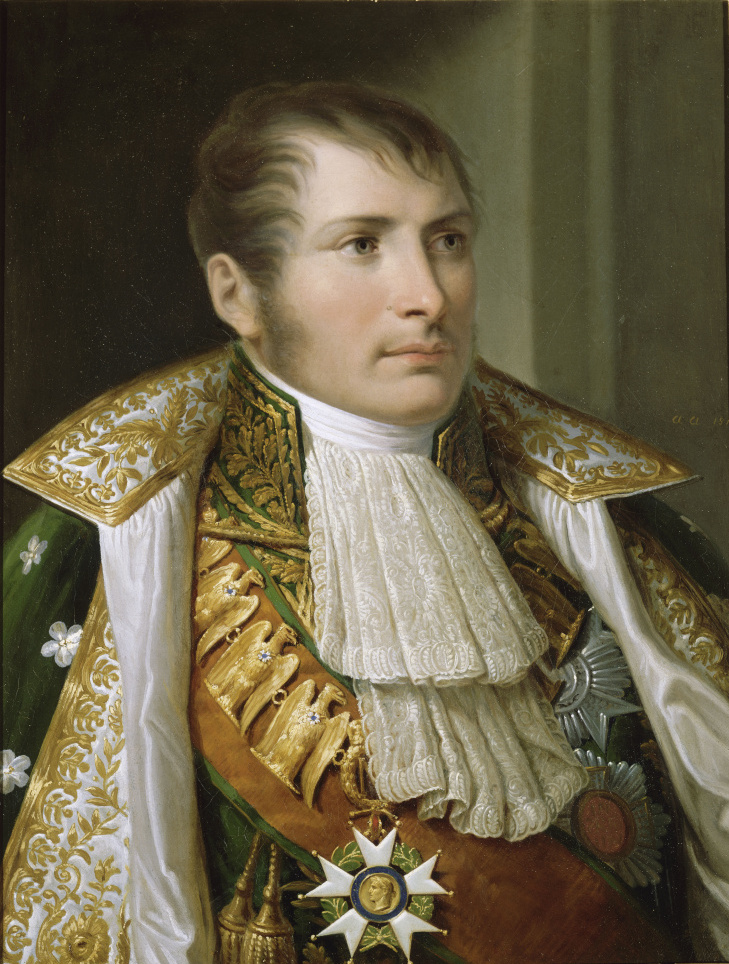
I'm sure I got a good bargain as it is what I suspected it to be, an Official Imperial Decree from 1806, issued by Eugène de Beauharnais in Milan, as Viceroy of the kingdom of Italy. 
 http://upload.wikimedia.org/wikipedia/commons/d/db/EugeneBeau.jpg
Perhaps there were thousands of these things nailed to notice boards in Northern Italy, and are still sitting in drawers all over the place. Needless to say, I'm happy with my little piece of Napoleonic History, and particulalry as Eugène de Beauharnais was a fairly decent chap (notwithstanding the punishments he listed in the decree).
I managed to read through and write down all the content of the decree, which I've been told is in slightly dated Italian. The subject of the Decree is the demand of the draft of troops from the years 1803, 1804, 1805, and 1806. The decree was issued in August 1806.

Napoleon was obviously anticipating (or planning...) that war would break out and was rapidly mobilising the draft for four years in Italy. Two months later Prussia declared war on France, and thus began the war of the Fourth Coalition. 

If you look at the translation you'll see what must have been fairly hefty financial sanctions for the families of draftees who failed to turn up  at barracks. It can be easily summed up: "by the grace of god and the constituion, give me your sons our give me your money..."

The decree certainly gives you a taste of just how our Corsican friend managed to raise all those armies, and how he was probably little grieved-after in many countries following his fall. 

So the text in English below,  followed by the original in Italian:

The translation of the text into (what I hope is correct) English is as follows:

NAPOLEON I

By the grace of God and the Constitutions of the French Emperor and King of Italy:

EUGENE NAPOLEON of France, Vice-King of Italy, Prince of Venice, archchancellor French Empire State, to all those who see the present health.

We, by virtue of 'which has been delegated authority from' Almighty and most August Emperor and King Napoleon I, Our Father honored and gracious Sovereign, we have decreed and ordained as follows:

Article 1. The old departments of Regua will make in the space of sixty days, counting from the publication of this decree, the draft must for the years 1803, 1804, 1805, and 1806.

2. The prefects are responsible for any fees and full compliance with the Whole previous article.

3. The fathers of the conscripts who were to be "refrattarj" (deserters?) to this decree, and in the absence of their fathers, their guardians will be required to pay in the public Treasury, and in the hands of the receiver of contributions of their Municipality or County, a fine of six hundred lire.

4. The fine will be paid in the month following after the sixty days granted by this Decree. Payment of the fine will not be able to deduct the "refrattarj" (deserter?), if they are later arrested for any of the penalties handed down against them under the old Act.

5. The receiver will require contributions of those fines with the same rights and duties allocated to them for the collection of regular contributions.

6. Gl 'conscription of individuals belonging to the year 1803, 1804.1805, and 1806 which have already been exempted for any cause whatever, will be subject to reconsideration.

7. This examination will be done in any place of Chief Prefecture by a commission composed by the Prefect of the Department, Captain of the Gendarmerie, a line officer in activity, by a physician and a surgeon appointed by the Prefect.

8. The Prefect will not be able to neglect in any case to preside over the operations of the Commission instituted colleagues' previous article.

9. The Ministers of Interior and the War are responsible, in ciascunno what it is concerned, the implementation of this Decree will be published and inserted in the Bulletin of the laws.

Since August 4, 1806 in Monza them.

Eugene Napoleon.
For the Vice-King;
The Board Secretary of State
L. Vaccari

Milan, the Royal Printing House [price money 2]


In the Italian original:

NAPOLEONE  I

Per la grazia di Dio e per le Costituzioni, Imperatore de'Francesi e Re d'Italia:

EUGENIO NAPOLEONE di Francia, Vice-Re d'Italia, Principe di Venezia, Arcicancelliere di Stato dell'Impero Francese, a tutti quelli che vedranno le presenti, salute.

Noi, in virtu dell' autorita che Ci e stata delegata dall' Altissimo ed Augustissimo Imperatore e Re NAPOLEONE I, Nostro onoratissimo Padre e grazioso Sovrano, abbiamo decretato ed ordinato quanto segue:

Art. 1. Gli antichi dipartimenti del regua compiranno nello spazio di sessanta giorni, a contare dalla pubblicazione del presente decreto, quanto debbono per coscrizione degli anni 1803, 1804, 1805, e 1806.

2. I prefetti sono risponsabili dell intiera  e piena esecuzione dell articolo precedente.

3. I padri dei coscritti che fossero per essere refrattarj al presente decreto, ed in mancanza de loro padri, i loro tutori o curatori saranno tenuti a versare nel Tesoro publico, e nelle mani del Ricevitore delle contribuzioni del loro Comune o Cantone, una multa di seicento lire.

4. La multa sara pagata nel mese succesivo dopo i sessanta giorni concessi dal presente Decreto. Il pagamento della multa non potra sottrarre i refrattarj, se sono posteriormente arrestati, ad alcuna delle pene contro di loro pronunciate dalle Leggi precedenti.

5. I I Ricevitori delle contribuzioni esigeranno le dette multe coi medesimi diritti e doveri che sono loro attribuiti per l'esazione delle contribuzioni ordinarie.

6. Gl' individui appartenenti alle coscrizioni degli anni 1803, 1804,1805, e 1806 che ne siano gia stati esentati per qualunque siasi causa, saranno sottoposti ad un nuovo esame.

7. Questo esame sara fatto in ogni Capo-luogo di Prefettura da una Commissione composta dal Prefetto del Dipartimento, dal Capitano della Gendarmeria, da un Ufficiale di linea in attivita, , da un Medico e da un Chirurgo nominati dal Prefetto.

8. Il Prefetto non potra dispensarsi in nessun caso dal presiedere alle operazioni della Commissione instituita coll' articolo precedente.

9. I Ministri dell'Interno e della Guerra sono incaricati, ciascunno in cio che lo concerne, dell'esecuzione del presente Decreto che sara pubblicato ed inserito nel Bollettino del Leggi.


Dato in Monza li 4 agosto 1806.


Eugenio Napoleone.
Per il Vice-Re;
I Consigliere Segretario di Stato,
L. Vaccari

Milano, della Reale Stamperia [ prezzo soldi 2 ]