Monday, January 20, 2014

Analogue Hobbies Challenge Entry - Mexican Revolution, and Chaco War


I've been a tad busy the last few weeks with a new job/project, so posting have been amiss. I've now fired in entries to two of the bi-weekly themes in the Analogue Painting challenge.
The first was a pair of figures inspired by the Wild Bunch film (a Peckinpah classic).

Both figures came from the excellent Mexican Revolution range brought out by Gringo 40's. I must say they were a real pleasure to paint and are full of character. I do hope Jed fills out the range more as it would be a great period to wargame (certainly as exciting as any Russian Civil War or Back of Beyond wargame).


Anyway the chap above is supposed to be the evil Mexican General Mapache from the film. Though judging from pictures he's probably based on Pancho Villa when he was briefly in Mexican Army uniform. I'll have to order another one from Gringo 40's as this lad is now winging his way to Canada as my entry fee to the Painting challenge.

 
The second chap is another "Federales" officer ("boo" I hear you shout). Another lovely sculpt, and he bears a striking resemblance to another character from the Wild Bunch film.


As this is two posts in one, my second entry were a pair of Chaco War inspired tankettes.

These two lovelies are Carden-Lloyds from Warlord Games. While not exactly the same as the versions deployed during the Chaco War, they come close enough for wargaming purposes (actual Bolivian Carden-Lloyd below with shorter cabin, sloping armour and sheet metal plate protection for the HMG).

As only a handful were ever used in the war, and nearly all were destroyed early on they'll do just fine. I lopped off the heads of a few of my Bolivian Chaco War figures to make the crew.

 
During the Battle of Nanawa (1933), these had been sent as part of a frontal; assault by the Bolivians, along with some light Vickers tanks and flamethrower teams against deeply entrenched Paraguayans. 

 
The battle was a bloodbath for the Bolivians who could not penetrate the deep defense, mines and barbed-wire erected by the Paraguayans (under the instructions of two Russian White Army officers who had extensive experience of the trench warfare on the Eastern Front). Hench why the battle is often referred to as the South American "Verdun."

Friday, January 03, 2014

Happy New Year - Part 2


So continuing on from Part 1... Happy New Year!   2013 was a pretty good year, though contracting opportunities, along with the economy seem to get worse with each year. Anyway, let's stick to the theme of the blog. It was a good start to the year with the Prague Wargames' Club annual pilgrimage to Salute in London. It was also a great opportunity to attend the Bloggers meet up for the first time; really excellent idea.

Apart from various family holidays and work commitments, the big adventure for 2013 was getting Orinoco Miniatures off the ground. It's still a tender chick that will need a bit more fattening up before I'm happy with it, but the omens seem good. One range seems to be up and running while another has just started. We'll see what interest will grow in the periods the figures cover this year.

Otherwise there was a lot of wargaming, especially both the "Dux's - Bellorum and Britanniarum, much painting, but not as much as planned, and some great walks of various battlefields (I visited various sites of the Piave front from WW1, as well as Kolin, White Mountain and Jankov again).

Now in terms of my resolutions for 2013, well I got about half way there (as I thought), though stretch goals are what I give myself, otherwise nothing would get done. So how does the scoreboard look?
  • Complete "The big project" – to run an Austerlitz (Slavkov) wargame in 28mm - well this is still ongoing. We've moved to back a few months. My partner in crime needed to finish his PHD this year, and the Orinoco Miniatures launch took up most of my focus
  • Adding to and adapting the French force from the Austerlitz game for the French Revolutionary wars - kind of half done as it just involves some extra command stands
  • Visit more battlefields - Done! The remaining reports on all those already visited will appear this month
  • Complete/bring to conclusion an exciting project I started early in 2012 - Done (this was the plan for Orinoco Miniatures), actually it went better to plan as I managed to get the Chaco War range running before year's end
  • Get the Dark Age Early Saxons finished during January (along with some lovely buildings from Gripping Beast), and get the ball rolling with dark age gaming in the club - all done
  • Complete another 1000 point force for General de Brigade (most likely 15mm Russians) - not done as I've changed my mind about  the scale and where I want to go with gaming Napoleonics
  • Seriously try to eat into the lead mountain: - not really done... Early Saxon army was painted, and Auterlitz army is half painted. Not much more than that.
  • Build more quality terrain for the club –  Well many buildings were painted (including for the Mediterranean), but not much terrain. Material for the trenches is now sitting on the workbench, though I may construct them for Chaco War rather than WW1 trenches (though WW1 stays on the list)
  • More regular blog posts, with a target for 2013 of at least 50 - well I reached 46. I had a number of other blog posts drafted, but didn't see the sense in rushing them out to make it to 50, so I feel that this goal was reached.
  • And the final and most important project is to finally sell property one and find  a larger house (with man cave) - fail I'm afraid. My better half and I are still looking for something suitable (the housing stock in Prague is in poor supply, of poor quality and generally overpriced; such is life).
 So 5 out of 10 done. So not so much having to eat my hat as a quick bite around the edges :-)

For 2014 a slimmer list:
  1. Get to my 1000 point target in the Analogue Hobbies Painting Challenge, this will also double for tackling the lead mountain in 2014
  2. Finish the Austerlitz project (and the extra command stands for the Revolutionary Wars)
  3. Put on a key battle from the South American Wars of Liberation with the new Orinoco Miniatures figures (if feasible maybe at one of the main shows towards years end, we'll see). Also as a secondary goal, a few Chaco War battles
  4. Bulk out both the Liberators and Chaco War ranges
  5. Keep to the target of another 50 blog posts this year
  6. Build more terrain, though as an aspiration (more storage space is wanting at the moment). It will just be a few trenches/foxholes and mortar pits for the Chaco War for now
  7. More battlefields visits goes without saying, though this is a pleasure not a chore. We'll see where work and travels take me for this one
  8. House move is still a big aspiration for 2014. We may have to force the hand of fate

So again, best New Year wishes to all, and success in 2014!

Tuesday, December 31, 2013

Happy New Year - Part 1

So Happy New Year to all from Prague (fellow bloggers included)! I'll leave the dissection of 2013, and the New Year resolution list til' the clear light of day. Wishing you all luck, success, and happiness in 2014. Cheers!

Prague Wargames club annual Christmas game

On Sunday we held our annual Christmas game at the Prague Wargames Club. Every year between Christmas and New year we try to put on a large Napoleonic game (usually in 15mm using General de Brigade rules). This year we managed to rent a hall opposite the Historic Prague new Town Hall (this is where the first Defenestration of Prague took place in 1419, which effectively started the Hussite Wars). You can see the tower of the New Town Hall below from the courtyard next to our gaming hall.


Usually we play a well known battle either from the Peninsular War or Central Europe. This year though one of our key members Petr came up with a new scenario based on a fictional encounter in 1813 in Central Europe. A French Corps was seeking to escape west and had to secure and cross a bridge in the town of Halle. Behind them in pursuit was a Prussian and an Austrian Corps, who themselves had to cross 3 defended bridges to get onto the campaign map.

The game began with orders and map movement. Each side played on a blank map (with just their own forces showing). The Umpire took the movement orders for each turn, and tracked them on his master map. After each turn he would inform each side if they had detected any enemy formations. On the map Light cavalry brigades could spot up to 3 squares away, whilst if any battle took place, the gunfire could be heard 6 hexes away (as in marching to the sound of the guns). You can see a copy of the map below, and the next map with movement counters for third force on it.


Unknown to the either the French, or the Austrian and Prussian Commanders was the fact that there was a third Corps of the British Expeditionary Force which appeared on the flank of the Campaign map. Their objectives were to link up with the Allied army, to delay the French were possible and try to capture either Halle (the prize), or a key crossroads and warehouse in the middle of the map.

The map maneuvering went on for an hour or so and enemy units were spotted and recorded, and some minor engagements began with the river crossings of the Austrians and Prussians (see the photos below).


After slowly advancing towards the centre of the Campaign map, my British Force decided to pin a French Division once we had confirmed that a large Austrian force was fighting its way over the river just to our North (we could hear the battle).  Below you can see the British marching in column onto the table from the bottom of the picture.

The British deployed in battle order just in time to receive a charge of massed French Columns of attack.
Meanwhile on the right flank, the Portuguese Brigade refused the French flank. The plan was to hold and defend against the French in anticipation of the arrival of a British Cavalry Brigade and the main Austrian army and so catch the French from both sides.
Below the British (the Welch Fusiliers to be precise) bring the French massed charge to a standstill with a well timed volley and canister from the artillery battery. Several more volleys and canister eventually routed a number of the French Units, until the French Brigade failed its morale test and retreated.
 
 
Eventually the British Heavy Cavalry Brigade appeared on my left flank and quickly saw off the French Light Cavalry.
Unfortunately, also marching to the sound of the guns another French Cavalry Brigade along with a Guard Brigade appeared behind the British line. While the British Cavalry held their own, one regiment of French Lancer regiments got through and smashed into the rear of the British line, routing the Welch Fusiliers (echos of Albuera I hear you say...)

 
As things were getting hot for the British, the Austrians, top heavy in artillery, finally turned up. But their slow plodding style had little effect on the outcome apart from pinning a few French battalions.
 
Whilst the British centre was unravelling, the British cavalry successfully stalled the advance of the French until daylight time ran out. The French centre was blown open, but the British in the centre had lost a key battalion and had only just passed their Brigade Morale Test. And so the game ended.

The result was a minor British victory in the battle. The other half of the British Corps had been involved in a holding action against the French further south, on the eastern approach to bridge to Halle, with their left flank anchored on the river. This was a mixed battle, disaster on the left flank where two whole brigades were routed, but success on the right where the French received a bloody nose from the Highland Division.


Overall a very bloody affair with several battles being fought simultaneously over several tables. In total we had over 20 divisional commanders in the whole campaign battle. The British emerged victorious having stuck to their plan to hold and stall the French, without themselves getting destroyed by superior numbers until their allies turned up. In the end it was an Allied victory, as one Austrian Division got around the French and marched into Halle first, thus holding the bridge and Halle's heavy fortifications; the French were thus trapped on the wrong side of the river as more Austrian and Prussian divisions concentrated on their position.

In conclusion, a great day's gaming and hats off to Petr for organizing such a clever and intuitive campaign game/battle day.


Monday, December 30, 2013

Chaco War photo shoot

Just trying out a new setup with the new miniature photo studio, a bit of terrain and the new Chaco war figures. The idea is to try and represent the "Green Hell" of the Chaco Boreal, which was dry jungle, scrub and cactii. I took these snaps about 20 minutes ago. I hope you like them.


New Chaco War figures


Just to let you know, a new range of 28mm figures have been released by Orinoco Miniatures. You can read more about them on the Orinoco Miniatures Blog

 
I think the war is really facinating and has great wargaming potential. Anyway, I hope you like the figures.


Thursday, December 26, 2013

Roman Limes Watchtower continued

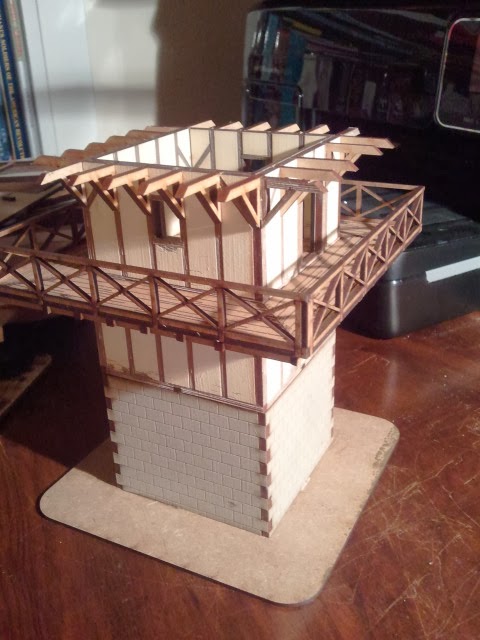
So I really got in to the modelling groove last night once all had gone to bed, and calm descended on von Browne mansions. Carrying on into the wee hours, I managed to get through nearly all the stages of constructing the Roman Watchtower from 4GROUND Models.

As I mentioned yesterday, this pre-painted model is excellent, the quality of the parts and how they are laser cut is first rate. That said though, there are quite a lot of parts to put together. The construction is not fiddly, though with some of the longer beams and supports you have to be careful when removing them from their frames as they can easily bend or snap (e.g. in the picture above I had to re-glue one of the long beams).

There are three main sections to construct in this model: the base/cellar section, the mid tower/sleeping quarters, which also support the observation balcony, and finally the upper floor of the guard room, with a door onto the balcony, and supports for the roof. (Above and below you can see the three sections before gluing the balcony onto the mid level supports).
 
Above a close up of the balcony and trellis guard rail. The detailing really is superb.
Below you can see the three sections fitting together, and finally with the balcony glued on.


The final stage was to construct the roof. I found this the most awkward bit, as the piece did not really have a tight fit. It took a couple of attempts to get it right, and then physically hold in place while the glue dried sufficiently. Below you can see the finished article, and some images of the detailing inside the guard room and sleeping quarters. You can also appreciate how many joists and supports have to be glued into place.


 All that's left to do is to sand and detail the base, and then glue the entrance ladder in place.  I can't praise the model enough, and this will be a great addition to my wargaming table.